Gravity assist maneuvers are incredibly useful for sending spacecraft far into space. The maneuver is like a skiing parent using a pole to give their kid a boost. The parent loses a bit of momentum, but leverage their larger size to quickly speed their kid up. The same is true for a gravity assist. There, instead of firing boosters to go directly to some far away place, the spacecraft flies towards a closer-by planet. Then, the spacecraft orbits around the planet, leveraging its gravity to launch it further into deep space. New Horizons was able to gain an additional 14,000 km/hr in velocity with a gravity assist around Jupiter.
But the laws of physics dictate that energy and momentum must be conserved. So, Jupiter slows down very slightly as the spacecraft speeds up. Effectively, the spacecraft is stealing some of Jupiter’s momentum and its energy. But this raises an interesting question: what would happen if you tried to do this in reverse? Gravity assists typically have the spacecraft and planet travel in the same direction (counter-clockwise). But if the spacecraft is orbiting in the opposite direction as the planet, can you send the spacecraft faster in one direction and the planet faster in the other? That would preserves momentum. But, if both increase their velocities, both would seem to have more energy, which would violate the laws of physics.
Unfortunately, there aren’t many good public-source orbital simulators that involve inter-planetary transfers. So I had to use the next best thing: Kerbal Space Program. KSP is a video game that uses a very basic model to simulate orbits. It assumes that every object is orbiting only one other object, and ignores the effect of other nearby planets. After all, in real life, the Moon’s distance from the Sun is very similar to the Earth’s distance from the Sun. So, you can get a good estimate of the Moon’s location by looking at its position relative to Earth as a function only of the Earth’s gravity, and then tracking the Sun’s effect on Earth separately.
So, using KSP, I did my best to plan a maneuver to do a reverse-gravity assist. Here are a series of pictures showing the gravity-assist I attempted:

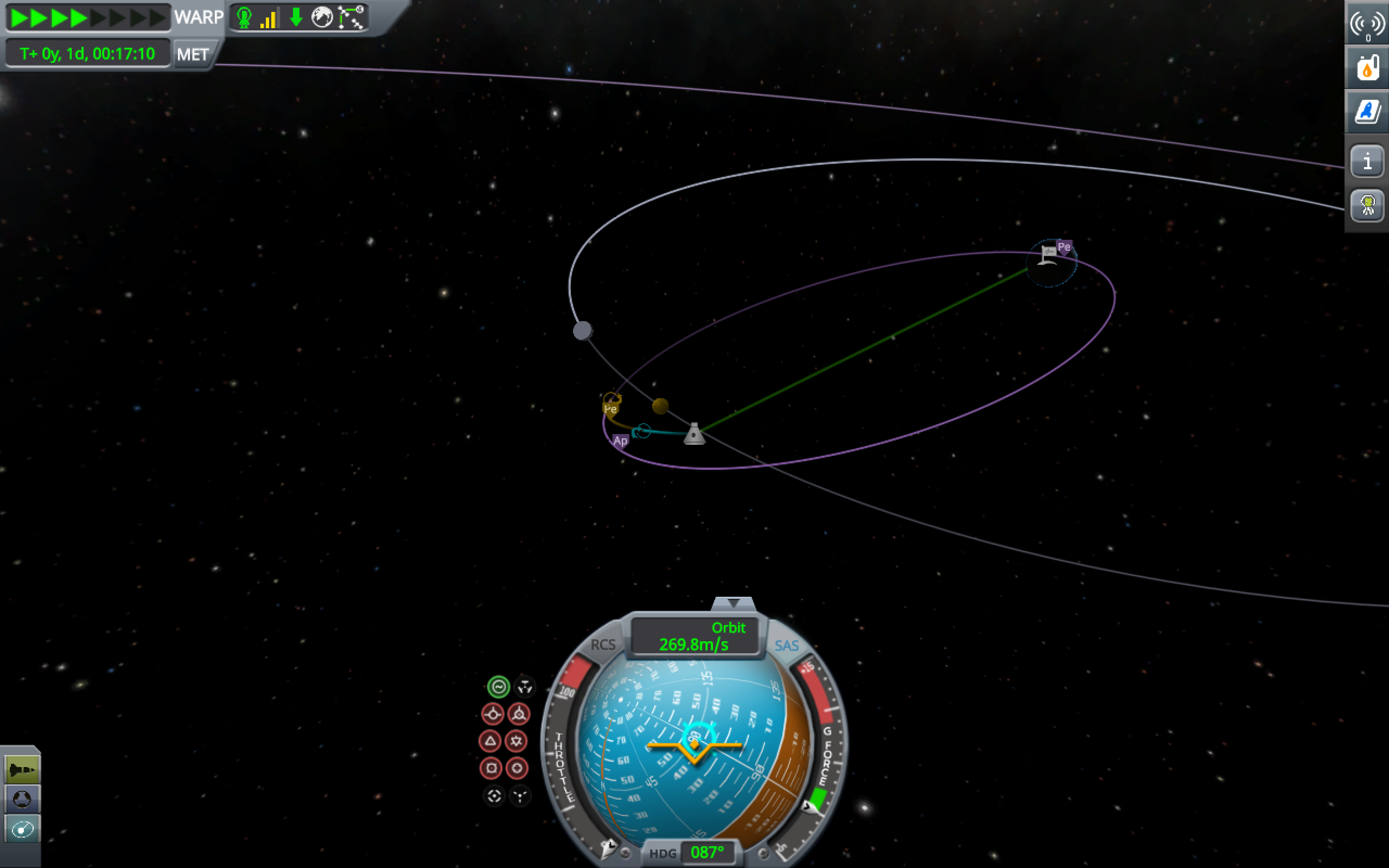

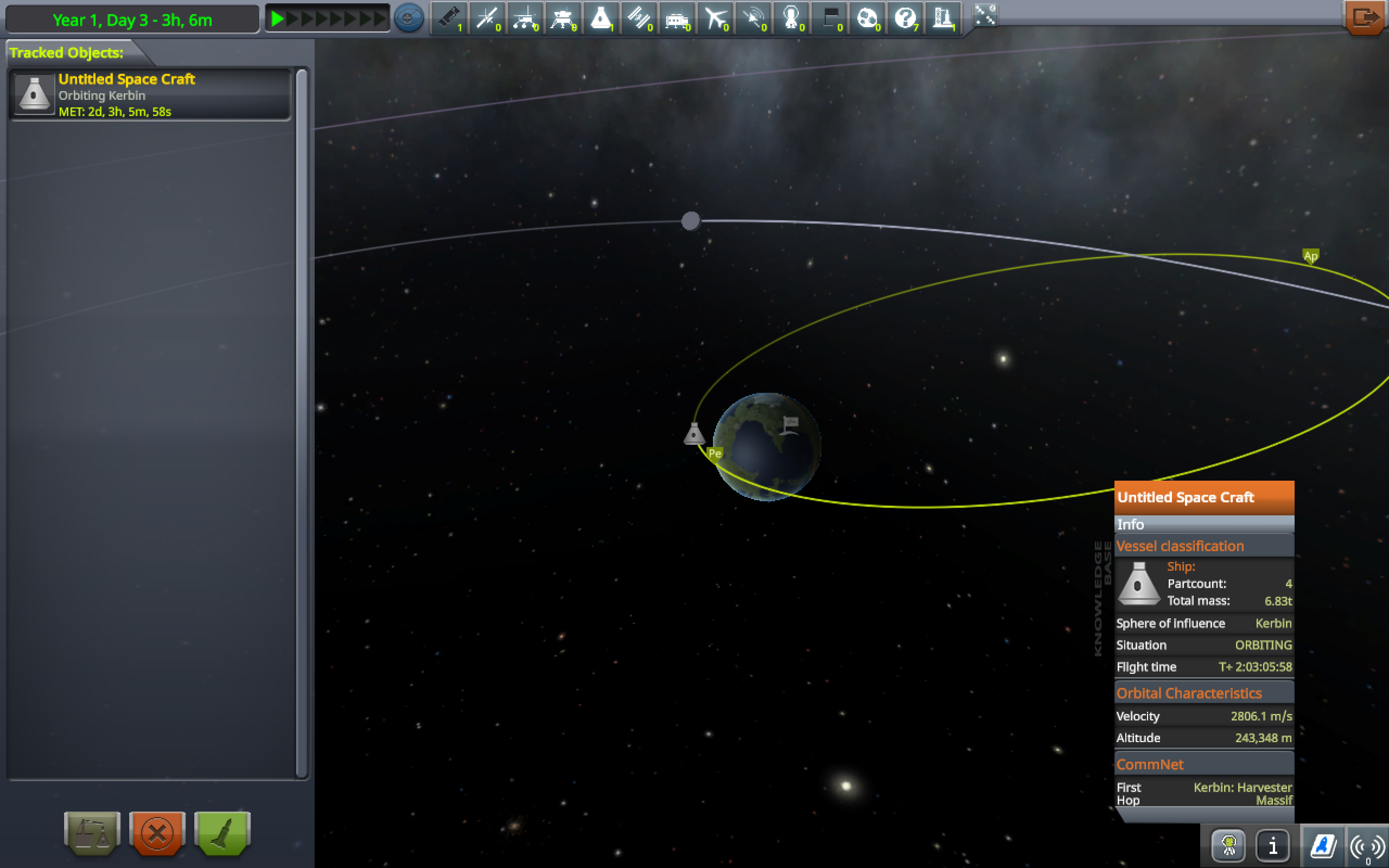
The maneuver did, technically, work. The spacecraft went faster despite its higher altitude. But it wasn’t close to the magnitude of effect from a traditional gravity-assist. And with a change in velocity of only 6.9m/s, KSP’s physics engine may have just shown something that a more accurate engine would show couldn’t happen. But it is worth noting that the spacecraft is further from the planet than the Moon when it enters the Moon’s sphere of influence. This yields a possibility: that the spacecraft accelerated towards the planet and the Moon accelerated away from the planet. This would decrease the Moon’s orbital velocity, conserving energy and momentum.
Fundamentally, though, I wanted to answer a simple question: could you do the sort of gravitational assist that’s typically possible if the spacecraft and planet orbit in opposite directions? And I got an answer: basically, no.
 Andrew's Astronomy Blog
You must be logged in to post a comment.